
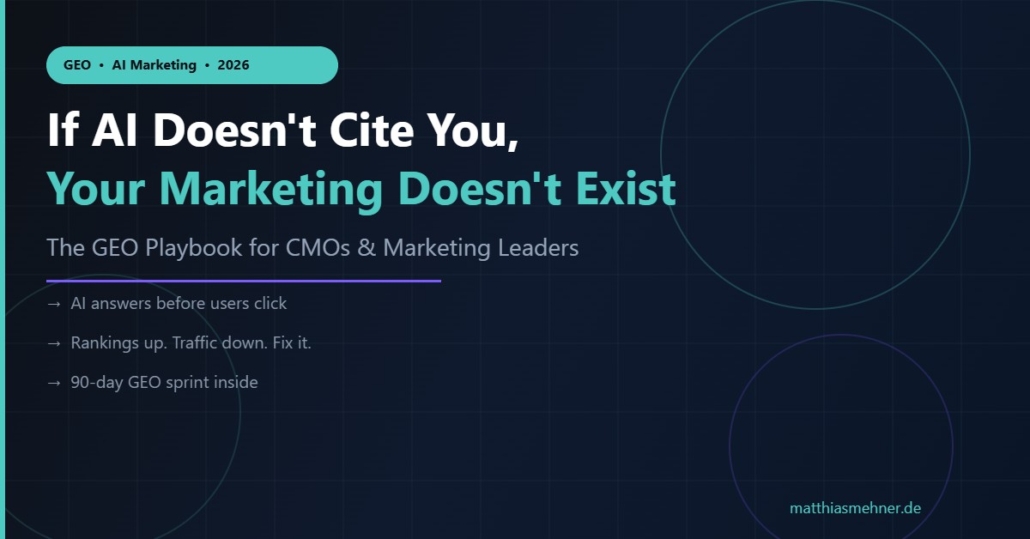
Here’s a scenario that sounds impossible — but it’s happening to marketing teams right now: your rankings on Google go up. Your visibility improves. And your traffic drops anyway.
This isn’t a bug. It’s the new normal.
AI tools like Google’s AI Overviews, ChatGPT, and Perplexity are answering user questions before they ever click on anything. They consume your content, extract what they need, and hand users a neat little summary — no visit required. Your best-performing article just became someone else’s AI response.
The question for every CMO and Marketing Leader right now isn’t “how do I rank?” It’s: how do I get cited?
TL;DR
- AI engines (ChatGPT, Perplexity, Google AI Overviews) are now the first stop for many users — your content can be extracted without generating a single click
- Rankings are becoming less relevant; AI citations are the new metric that matters
- Real-world case study: a German utility company doubled non-brand traffic by rebuilding their content strategy around user questions — not keywords
- GEO (Generative Engine Optimization) requires a fundamentally different content architecture than traditional SEO
- This is the biggest shift in digital marketing in a decade — and most marketing teams haven’t adapted yet
The Visibility Paradox of 2026
Let me be direct about what’s happening. The old model looked like this: user has a question → types it into Google → clicks a result → lands on your site. Done.
The new model looks like this: user has a question → asks ChatGPT or uses Google AI Overviews → gets an instant answer → never visits anyone’s site. Maybe.
Neil Patel put it bluntly recently: “Your rankings can go up while your traffic goes down. Your content can be ‘seen’ without being clicked. And your brand can be invisible if it’s not cited.”
Think about what that means for your marketing funnel. The top of funnel — awareness, discovery, consideration — is increasingly happening inside AI interfaces. If you’re not the source being cited, you simply don’t exist in that moment. No impression. No brand recall. No lead.
This isn’t a distant future problem. It’s this quarter’s problem.
What This Means for Your Business
- Stop measuring success purely by organic traffic — add AI citation tracking to your KPI dashboard
- Review your top 10 traffic-driving pages: are they structured so AI can extract clear, quotable answers?
- Budget for a GEO audit in Q3 — this should be as standard as an SEO audit by now
GEO Is Not Just “Better SEO”
A lot of people are treating GEO (Generative Engine Optimization) as an extension of SEO. Write longer articles, add more headings, be more thorough. That’s not it.
GEO requires a fundamentally different content architecture. Here’s the core difference:
SEO optimizes for ranking signals: backlinks, authority, keyword density, page speed. The goal is to be visible when someone searches.
If you want to go deeper on why this shift is fundamentally different from anything that came before, read my earlier breakdown: GEO Is the New SEO: Why AI Citations Beat Rankings in 2025.
GEO optimizes for extractability: clear statements, structured answers, explicit language that an AI can pull out and present as a reliable citation. The goal is to be useful when an AI summarizes.
AI engines prefer content that:
- Makes definitive statements (“The best approach to X is Y because Z”)
- Answers questions directly and early — not buried three paragraphs in
- Uses structured formats: bullet points, numbered lists, FAQs
- Contains specific data points, not vague claims
- Is authoritative: consistent brand mentions, third-party references, expert sourcing
One more thing that often gets overlooked: brand mentions outside your own website are increasingly influencing how AI perceives your authority. Press coverage, industry references, LinkedIn posts, podcast mentions — these all feed into the signals AI uses to decide whether to cite you.
In other words, GEO is a distribution game as much as a content game. For a deeper look at how AI engines read and interpret your brand signals, see: AI Is Writing Your Brand Story — And Your Website Is the Last Thing It Reads.
A Real Case Study: What GEO Actually Delivers
Here’s a concrete example from the German market. Marketing expert Robin Heintze recently shared details of a project his agency did with DEW21 — a regional utility company. Not a SaaS startup, not a big tech brand. A utility company in B2B.
The results after restructuring their content strategy around GEO principles:
- Significantly more organic traffic — not just branded, but non-brand traffic from people who didn’t already know the company
- Massive increase in visibility — content now appearing in Google AI Overviews
- Direct revenue impact — local landing pages designed for specific user questions generated measurable conversions
What made the difference? Three things: first, a comprehensive content audit that removed or redirected low-quality old pages. Second, rebuilding content around specific user questions rather than generic keywords. Third, treating GEO signals as equal to traditional SEO signals from day one.
The “SEO is dead” crowd has been wrong every time they’ve made that claim. But the game has genuinely shifted. SEO isn’t dead — it just has a more demanding co-tenant called GEO.
What This Means for Your Business
- Run a content audit focused on answer quality, not just traffic: which pages give a clear, direct answer to a specific question?
- Identify your top 5 customer questions and rewrite dedicated pages around each — structured for AI extraction
- Start tracking brand mentions outside your website: media coverage, LinkedIn shares, industry publications
AI Is Also Rewriting Your Emails
It’s not just search. The same dynamic is playing out in email marketing — and most teams aren’t ready for it.
Gmail and Apple Mail have moved beyond spam filters. AI-powered email summaries are now the default for many users. That means your subscribers may be consuming your message without ever opening your email. The AI decides what parts get surfaced. Not you.
For email marketers, this changes one fundamental rule: your most important message needs to be first. Not the second paragraph. Not after the header image. The first sentence.
If your email starts with “Hey there! Hope you’re having a great week! Before I get into things…” — the AI summary is going to be useless. If it starts with “We’ve just cut our enterprise pricing by 30% — here’s what that means for your team” — suddenly the summary does your job for you.
Click rates may drop even when actual business performance doesn’t. This will confuse dashboards. The fix isn’t to optimize for clicks — it’s to optimize for conversions and revenue metrics that actually matter.
What This Means for Your Business
- Audit your last 5 email campaigns: does the most important message appear in the first two sentences?
- Redefine your email KPIs — move away from open rates and clicks toward downstream revenue and conversion events
- Test “AI-first” email formats where the subject line and first sentence together tell the complete story
What the Next 90 Days Look Like
Here’s a 90-day GEO sprint that works:
Month 1 — Audit and prioritize. Identify your 20 highest-traffic pages. Test which ones show up in AI Overviews or ChatGPT answers for relevant queries. For the ones that don’t: why not? Is the language ambiguous? Is the answer buried? Document the gaps.
Month 2 — Rewrite for AI extraction. Take your top 10 priority pages and rebuild them with GEO in mind. Add direct-answer sections. Add FAQs. Make definitive statements. Use structured headers that answer questions, not just label sections. “Our Pricing Strategy” tells an AI nothing. “How We Price Enterprise Plans (And Why)” is extractable.
Month 3 — Build external authority. Pitch 3–5 industry publications for original bylines or expert quotes. Engage actively on LinkedIn with content that builds topical authority. Update your email strategy with front-loaded, AI-friendly formats. Track AI citation visibility using tools like Ahrefs or manual spot-checks.
The companies doing this now will own the AI citation layer. Everyone else will watch their traffic decline while their rankings stay flat — confused about what went wrong.
Want to go deeper on GEO strategy?
I write about AI, digital transformation, and modern marketing every week. If this kind of thinking is useful for you, subscribe to my newsletter — and feel free to connect with me on LinkedIn to continue the conversation.

Über den Autor
Matthias „Matze“ Mehner
VP Marketing bei Mailjet by Sinch. Ich schreibe über AI, digitale Transformation und modernes B2B-Marketing — mit einem Fokus auf das, was für Wachstum wirklich zählt. Kein Fluff, keine leeren Buzzwords. Nur das, was funktioniert.
Frequently Asked Questions
What is GEO and how is it different from SEO?
GEO (Generative Engine Optimization) is the practice of optimizing your content to be cited by AI search engines like ChatGPT, Perplexity, and Google’s AI Overviews. While SEO focuses on ranking in traditional search results through signals like backlinks and keywords, GEO focuses on making your content extractable and citable — clear, structured, and authoritative enough for an AI to confidently reference it.
Why is my organic traffic dropping even though my rankings haven’t changed?
This is the “visibility paradox” of 2026: AI tools are answering more queries directly without sending users to websites. Your page may still rank well but never get clicked because an AI Overviews snippet answered the question at the top of the page. The solution is to optimize for AI citations — so your brand still appears in the answer even without the click.
How do I know if my content is GEO-optimized?
A simple test: ask ChatGPT or Perplexity a question your content is supposed to answer. If your brand or content gets cited, you’re on the right track. If a competitor appears instead — or if the AI gives a generic answer with no source — your content likely lacks the structure AI engines need to cite it.
Does GEO replace SEO or work alongside it?
GEO works alongside SEO — you still need traditional ranking signals. The good news: GEO improvements (clearer writing, better structure, more authoritative content) almost always improve SEO performance too. They’re complementary, not competing.
How long does it take to see results from a GEO strategy?
Teams that focus on high-priority pages first can start seeing AI citation improvements within 4–8 weeks. Broader visibility gains in AI search engines typically show meaningful results in 3–6 months — roughly comparable to traditional SEO timelines.






Dein Kommentar
An Diskussion beteiligen?Hinterlasse uns Deinen Kommentar!