

Everyone is getting vibe marketing wrong. And I mean everyone.
Search for „vibe marketing“ right now and you’ll find articles about emotional brand vibes, AI-generated content, lean teams replacing agencies, and Spotify’s AI DJ. It all sounds exciting. And it’s all missing the actual point.
Here’s what I believe: vibe marketing isn’t about using AI tools to feel like a cool marketer. It’s about the fact that the entire interface of marketing has shifted — from clicking through software to having a conversation. That shift is bigger than any tool. And most SaaS companies haven’t figured it out yet.
TL;DR
- Vibe marketing isn’t about AI tools or emotional branding — the real shift is the conversational interface replacing click-based software
- Using AI to write copy faster is just modern marketing — we didn’t call it „PowerPoint Marketing“ when slides took over either
- The new marketer talks to their stack: „Send this campaign to my top 100 buyers who like red shoes — give price-sensitive ones a discount“
- This is the first real path to hyper-personalization at scale — without needing a developer or 12 clicks
- Most SaaS marketing tools still aren’t ready for this. That gap is the biggest opportunity in martech right now.
What Vibe Marketing Is NOT
Let me be direct: using Claude to write your email subject lines is not vibe marketing. Using Midjourney to generate ad creatives isn’t vibe marketing either. That’s just marketing in 2026. The same way using PowerPoint for presentations wasn’t „PowerPoint Marketing.“ Or building a landing page wasn’t „HTML Marketing.“
Tools evolve. Marketers adopt them. That’s the baseline — not the revolution.
The current mainstream definition of vibe marketing — AI-assisted content creation, emotional tone-setting, lean teams doing more with less — describes the tools, not the shift. And when you define a movement by its tools, you miss what the movement actually is.
Nobody said „search engine marketing“ the moment Google launched. They said it when the behavior changed — when people started searching for intent, not browsing by category. The tool was the trigger. The behavior was the shift.
Vibe marketing is the same. The trigger is AI. But the shift is the interface.
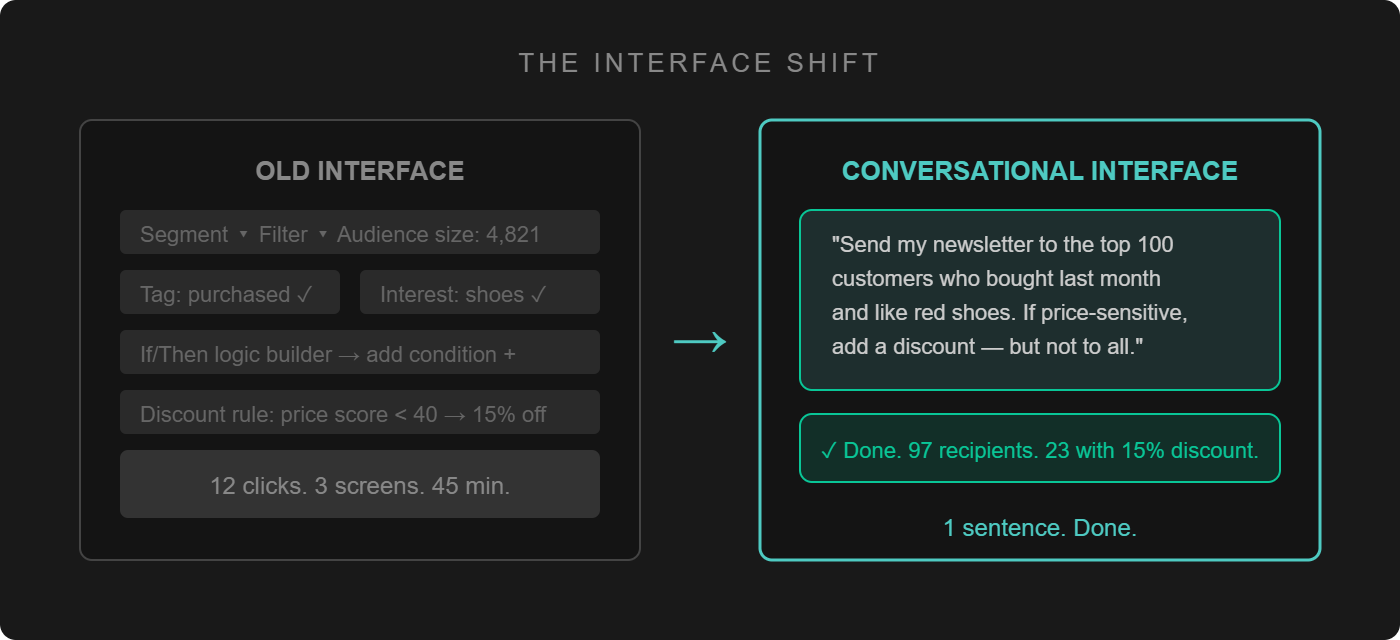
Marketing used to require 12 clicks across 3 screens. Vibe marketing does it in a sentence.
What Vibe Marketing Actually Is
Vibe marketing, as I define it, is this: every marketing action — strategy, execution, personalization, optimization — happens through conversation. You talk to your marketing stack. Your stack responds. And the result is more precise, more personal, and faster than anything a click-based interface could produce.
Think about how we used to work. You’d open your CRM or your email platform, navigate to „Segments,“ add filters for purchase behavior, layer in interest tags, build an if/then rule for discounts, preview the audience, create a variant, test, schedule — and 45 minutes later, you’d hit send on something that’s still only half as targeted as you wanted it to be.
Now imagine this instead:
„Send my newsletter to the top 100 customers who bought last month and are interested in red shoes. If they’re price-sensitive, include a 15% discount — but don’t give it to everyone.“
One sentence. Done. That’s not a fantasy — that’s where the interface is going. And this is the actual definition of vibe marketing. Not the AI. Not the vibes. The conversation as the operating system for marketing.
What This Means for Your Strategy
- Stop evaluating your martech stack by features — evaluate it by how conversational the interface is
- If your tool still requires 10+ clicks to segment an audience, it’s already behind
- The marketers who learn to talk to their stack instead of clicking through it will out-execute everyone else
The First Real Path to Hyper-Personalization
Here’s why this matters beyond convenience: hyper-personalization has always been the goal. Conversational marketing is finally the path to get there.
For years, marketers have talked about sending the right message to the right person at the right time. In practice, it required data teams, developer support, complex automation builders, and weeks of setup. The result? Most companies settled for three or four audience segments and called it personalization.
The conversational interface changes this completely. When you can express marketing logic in plain language — „if this customer bought twice but hasn’t opened an email in 60 days and their average order value is above €150, send them this“ — you remove the technical barrier between intent and execution. Every marketer becomes a power user. Every campaign becomes genuinely targeted.
This is the first step toward marketing that actually adapts to people, not just groups of people.
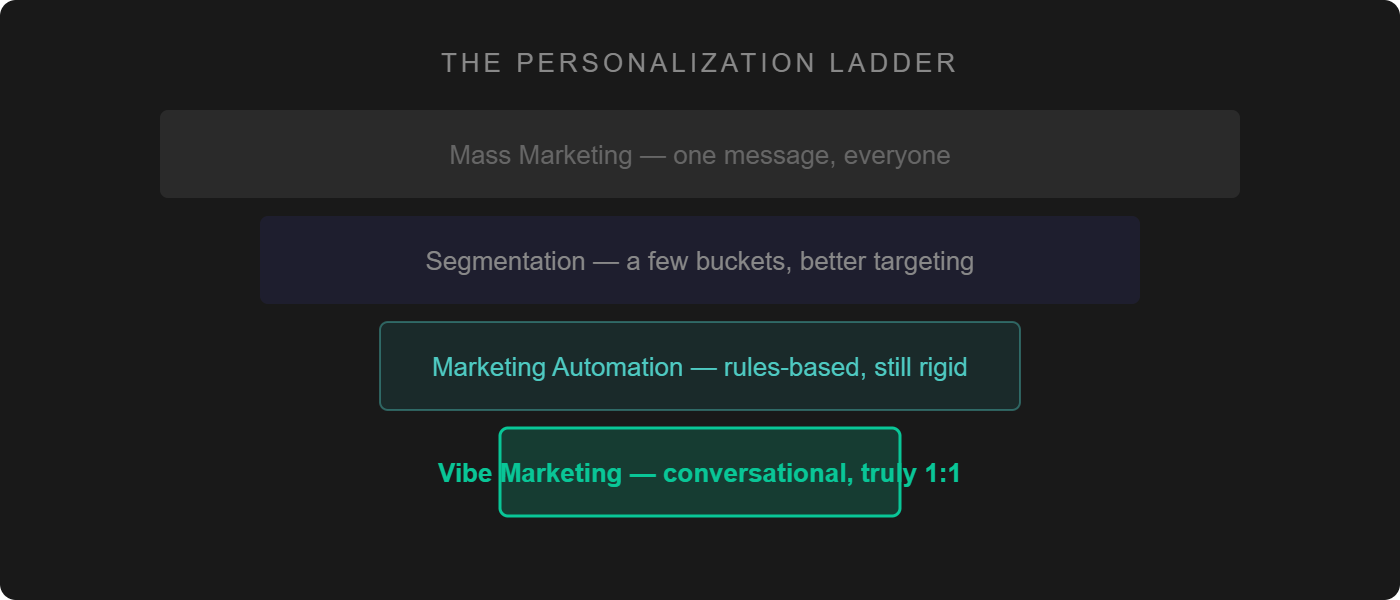
Hyper-personalization was always the goal. The conversational interface is finally the path.
Why Most SaaS Tools Aren’t Ready
Here’s the uncomfortable truth for the martech industry (and if you want to understand how AI is reshaping discovery too, read my take on GEO vs. SEO): most platforms are still built around the old interface. They’ve added AI features — a „generate with AI“ button here, a smart subject line suggester there — but the core UX is still click-based.
Old Marketing UX
- Click through 7 menus
- Drag-and-drop editor
- Manual A/B test setup
- Export → Import → Format
- Hours of configuration
Vibe Marketing UX
- „Send a campaign to churning users“
- AI generates copy + design
- Auto-optimizes in real time
- One prompt, full execution
- Minutes, not hours
Still form-fields. Still dropdown menus.
That’s not vibe marketing. That’s legacy software with an AI sticker on it.
The tools that will win the next decade aren’t the ones with the most features. They’re the ones that make a marketer feel like they’re talking to an intelligent colleague, not operating a complicated machine. The ones where you can say what you want in plain language and the platform figures out the rest.
We’re early. Most platforms aren’t there yet. But the gap between where tools are and where marketers need them to be — that’s the biggest opportunity in martech right now.
What This Means for SaaS Founders & CMOs
- For SaaS founders: If your product still requires users to click through 5 screens to run a campaign, you’re already being disrupted. The roadmap question isn’t „what features should we add?“ — it’s „how do we make this conversational?“
- For CMOs: Audit your stack not just for ROI but for interface quality. How many of your tools would survive being replaced by a well-prompted AI agent?
- For everyone: Train your team to think in intent, not workflow. The skill of the next decade isn’t knowing which button to click — it’s knowing how to express what you want clearly.
The Vibe Marketing Definition That Actually Holds Up
Let me put it plainly:
Vibe marketing is the shift from operating marketing software to conversing with it. It’s when the interface itself becomes invisible — replaced by intent expressed in natural language. It’s the first genuine step toward hyper-personalization at scale, because it removes the technical layer between a marketer’s thinking and the campaign’s execution.
It has nothing to do with emotional vibes or aesthetic moods. And it has nothing to do with AI being new — AI is just the enabling technology, the same way SMTP enabled email marketing without being called „email protocol marketing.“
The real question isn’t whether vibe marketing is a trend. It’s whether your tools and your team are ready for the conversation.
Frequently Asked Questions
What is vibe marketing — the real definition?
Vibe marketing is the shift from click-based marketing software to conversational interfaces — where marketers express their intent in plain language and the platform executes it. It’s not about AI tools or emotional branding; it’s about the interface becoming a conversation.
How is vibe marketing different from marketing automation?
Marketing automation relies on pre-defined rules and click-based builders. Vibe marketing lets you express complex logic in natural language — „send this to price-sensitive customers who bought twice but haven’t engaged in 60 days“ — without building a workflow manually. The result is faster, more precise, and accessible to any marketer, not just technical ones.
Is vibe marketing just another name for AI marketing?
No. AI is the enabling technology, but vibe marketing is about the interface shift. Saying „vibe marketing = AI marketing“ is like saying „email marketing = SMTP marketing.“ The protocol enables it, but the behavior is what defines it.
Which SaaS tools support conversational marketing today?
Most don’t — not fully. Some are moving in this direction with AI copilots and natural language query features, but the majority still rely on click-based UX with AI bolted on. The gap between where tools are and where marketers need them is exactly where the next generation of martech will emerge.
What skills do marketers need for vibe marketing?
The ability to express marketing intent clearly in plain language — what audience, what message, what condition, what outcome. The marketer who can think in clear, specific prompts will outperform the one who knows every dropdown in the old software.
Photo by Mimi Thian
on Unsplash
About the Author
Matthias „Matze“ Mehner is a serial entrepreneur, investor, and one of the most sought-after experts in Messenger Marketing, Chatbots, and Conversational AI in the German-speaking world. He was among the first to recognize the business potential of WhatsApp & Co. — founded multiple startups, built MessengerPeople from zero to €10M ARR, and led the company through a successful exit to Sinch AB. Today he serves as VP Global Marketing at Sinch, while actively investing in and advising AI and SaaS startups including Emma.AI and socialpals — sharing his expertise as an author, speaker, and thought leader at the intersection of AI, messaging, and digital transformation.
📩 matthiasmehner.de ·
💬 Telegram Newsletter ·
🔗 LinkedIn




Dein Kommentar
An Diskussion beteiligen?Hinterlasse uns Deinen Kommentar!